Showing posts with label CELG. Show all posts

Saturday, July 25, 2009

Decoupled moves in Biotech indices highlight opportunities and challenges

The chart below shows returns for the last 6 months of the two Biotech indices that I follow: BTK and NBI.

After a significant and equivalent downside move in March, both indices have turned positive with an explosive move since middle of July. I speculate that the March downside move was a response to concerns over Obama's health care proposal and its impact on Medicare. However, upon further examination, the adjustments in Medicare rebates would translate to no more than a double digit change in revenues. Moreover, the biotech story is in large a product story where launch of a new product has a much higher impact on revenues than any adjustments in rebate system which can be overcome with cost and price adjustments and while keeping healthy profit margins.

The explosive returns in July are rather interesting and may be indicative of things to come. The divergence in the charts of two indices (35% return for BTK vs. 12% for NBI) underlying story of the biotech industry. This trend indicates a value disparity between mid-large cap biotechs and smaller companies. The BTK move can be contributed to recent earnings and product advancement reports coming out of Celgene (CELG), Gilead (GILD), Amgen (AMGN) and other pharma companies that highlight decent earnings growth despite a challenging environment in addition to value added product development successes.

The M&A activity over the last few quarters have just contributed positively to perceived value of these stocks as the recent acquisition of Medarex (MDRX) highlights a larger trend of big pharma acquiring biologics assets and capabilities. This has resulted in speculative run-ups in shares of other companies such as Elan(ELN) and Seattle Genetics (SGEN) who have biologic portfolios. This trend, however, could reverse as rapidly if no new deals are announced in the next few months.

The muted returns in the NBI index highlights the financing concerns that still remain for smaller companies which may cause a wave of consolidations, bankruptcies and asset sales at depressed values.

My favorite large cap names are Genzyme (GENZ) and Amgen(AMGN) and Biomarin (BMRN) and Vertex (VRTX) among mid-sized companies.

Disclosure: The author has no direct stock or option positions in any of the stocks mentioned in this article.

Thursday, September 18, 2008

Celgene (CELG) is a bargain once again

The latest crash of the financial markets has created some great buying opportunities in the health care sector. You can almost pick any Biotechnology or Pharmaceutical stock and be guaranteed that it is undervalued today. The sell-off was steep and broad and took down good stocks with the bad. It certainly felt like some hedge funds were desperately liquidating anything in their portfolio. The financial stock selling was only exasperated by a crash in commodities to create a avalanche effect that may not be over yet.

This has created a great buying opportunity in names such as Amgen (AMGN), Genentech (DNA), Genzyme (GENZ) and Celgene (CELG) to name a few.

Celgene recently reported great earnings report highlighted by a higher than expected sales from its Multiple Myeloma drug, Revlamid. Sales were up 80% from a year ago and translated to a very nice 26 cents per share earnings or double last year's numbers. This was slightly unexpected as analysts were widely expecting to see some signs of weakening of sales due to competition from Velcade from Takeda Pharmaceuticals ( acquired through purchase of Millenium Pharmaceuticals). The company also raised its full year guidance to $1.5 /share from $1.45.

More recently, Celgene announced that its Small Cell Lung Cancer drug, Amrubicin was given fast track status by the FDA. Amrubicin is being currently tested against GSK's Hycamtin in patients with refractory SCLC.

But, the news have not all been positive for Celgene. The FDA recently published a report that Revlimid may have an association with Stevens Johnson. Stevens Johnson has been on the label of Thalidomide as a potential issue and since the two drugs are of the same class, having that warning added to the label should not cause drop in sales specially considering that Multiple Myeloma is a deadly disease.


Celgene is trading at $64.3 with a market cap of about $29 Billion. It recently hit a high of $76 in August. The recent sell off due to the FDA warning and the financial crisis has created a great buying opportunity for a stock that can trade into the $80's next year.

Disclosure: The author has no positions in CELG stock or options.

Sunday, October 29, 2006

Celgene (CELG) Q3 earning update

Celgene just reported a great Q3 earings report which included strong sales form both Revlimid and Thalidomide. I have previously written about this company and previous earnings and valuations which can be viewed here.

After the great earnings report the stock gapped up to $47.5 and has climbed to $50.5 since as the chart shows. The recent run up may have been too much too fast. As the chart shows, the 50 day moving average is under $44. This would be a good time to take profits or make some money from selling calls. My strategy is to write covered calls at $50 strike price for January ( currently at $3.7. It is highly probable that CELG may even test its 200 MVA in the next two months which would make for a great buying opportunity.

JMHO

Wednesday, September 13, 2006

CELG still has upside potential

CELG is one of the few profitable biotech companies in the middle of a growth phase. I first discovered this growth stock in March of 2005. Since then the stock has more than doubled and split once. In this article, I will present some arguments why it is an attractive stock to purchase.


Products
CELG's products ranked by revenue are Thalomid(Indications: Multiple Myeloma,ENL), Revlimid(Multiple Myeloma, MDS), Alkeran(Multiple Myeloma and Focalin(ADHD). Revlimid
and Tholomid are from the same class of immunomodulary drug(IMiD). Revlimid is the newer generation with a better drug profile (better potency and toxicity).

Most recent Revenue and Earnings

Here are the sales numbers for CELG's major products for the last three quarters ( in million dollars)


TotalThalomidRevlimidother
Q42005149106340
Q120061821073243
Q22006197107636

Obviously, growth for CELG has been driven by Revlimid. In addition to sales in MDS, Revlimid has been cannibalizing Thalomid sales in Multiple Myeloma. Since CELG pays 1% in royalties for Revlimid compared to 10% for Thalomid, the cannibalization is actually boosting the profit margins of CELG. Another concern is the RevAssist program. Since Revlimid is a new product, the company is providing free samples to new patients and patients that have received this product during a clinical trial. According to the management, this represents 20-25% of the prescriptions. This may be a short term concern for revenues but in the long term it will allow more patients to try Revlimid and become paying customers. This practice is very common in the pharmaceutical industry. During the conference call, the management expects this percentage to drop closer to the industry average of 3-5%.

In addition, last quarter saw a decline in Alkeran. In the conference call, the management addressed this as issues with reimbursement and in manufacturing. They think the sales for Alkeran will recover but they want to be conservative about it.


Stock movement

After a seemingly unstoppable run that started last year and saw the stock price more than double, CELG has been off of it's all time high of about $49 back in July to as low as $41. Part of this is attributable to inflation and recession fears in the market. This profit taking is normal and has coincided with the summer months that historically see low volumes and high volatility.
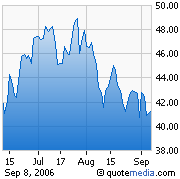


At $41 it is trading at about 80X 2006 earnings (0.51/share estimated) and 38X 2007 earnings (1.09/share estimated). This transaltes to a PEG of about 0.7 (using current PE of 80). To put this in perspective, I have made a table of the same data for other large cap biotech stocks:
Click on the image to enlarge.


These data suggest that CELG is the most expensive stock in that group according to 80 PE but has the highest growth rate at 114%. In fact, if you combine the PE and growth rates in form of PEG, it has the best value with a PEG of 0.71 in this group.

Other factors to consider

CELG is applying for approval of Revlimid in Europe. if approved, this should add significantly to the expected revenues and earnings. The cost of this expansion into europe is already priced in because the company has announced the costs of regulatory filings and has already put into place sales and distribution channels.

In addition, Revlimid is in clinical trials for treating Chronic Lymphocytic Leukemia(CLL) and aggressive non-Hodgkin's lymphomas (NHL) as well as non-deletion 5Q MDS. These, if successful, can add significant revenues in the coming years.

Bottom line:

CELG enjoys a monopoly in blood related cancers with its successful pipeline of IMiDs. Cannibalization of Thalomid by Revlimid is actually good for CELG as it causes profit margin expansion. Additional approvals in Europe and in other diseases would add significant upside potential to current estimates. Downside risks include changes in reimbursement from government or insurers as well as if Revlimid does not get necessary approvals in above mentioned trials. In the long term, CELG has some interesting small molecule kinase inhibitors and other immunomodulators that could allow it to expand into other therapeutic areas including other immune related diseases such as Psoriasis.

As far as trading CELG. I am waiting for the stock price to reach the 200 MVA which is currently around $37. This does not necessarily mean that I am waiting for the stock to drop. The stock could remain above $40 while the MVA moves up over time. I think the third quarter earnings will not be as disappointing as the last one. At $49 CELG's valuation was getting ahead of its earning. But a good Q3 and announcements regarding EU approval and clinical trial developments could send this stock towrds $50 where I think this stock will end up at the end of this year.

Disclosure: As of Sept 13, I own option positions in CELG. They inclue April 2007 $40 call options priced around $7 partially hedged by October$37.5 put options priced around $1. The stock price was around $40.5 when these positions were opened. The goal is to close these positions if CELG moves towards $50 in the near term for a gain of at least %40, or if there is a sharp decline towards $37.5 with a loss of about 10-20%. This will depend on the timing of the move and other outside factors such as volatility.

JMHO