These are my opinions on some stocks that I follow and/or own. They are not to be considered as investment advice. I will try to post as many accurate facts as I can. If you disagree with my opinions or have noticed an error in my statements feel free to send me your comments. Please do not follow my advice unless you are willing to lose money without blaming me or taking legal actions! I encourage you to do your own homework and understand the risks before making any investments.
Saturday, July 25, 2009
Decoupled moves in Biotech indices highlight opportunities and challenges
Tuesday, July 08, 2008
Biotechnology sector has a rare explosive day
As the list below shows, both the BTK and NBI indices both had about a 3.8% increase in volume with convincing volume in the big biotech names. If a 3% down day is conisdered a crash, a 3.8% up day could qualify as an explosion! Some of these stocks went up even much higher thatn the average for the sector!
BTK, NBI, BBH, DNA, AMGN, GENZ, GILD, BIIB, AMLN, CEPH
In addition, there was quite a nice move in a lot of small and mid cap biotechs as well. The list below shows some of the names that I follow. I would be a little more careful about some of these smaller cap names as they could easily and quickly give back the gains they made today and more.
VRTX, HGSI, GNBT, IMCL, ALNY, PTIE, SGEN, VPHM, VRUS, RIGL.
Of course, one day does not make a trend. I am puzzled at the cause of this rather massive one day move in this sector. A short squeeze move is unlikely because the sector has not been down relative to other sectors. It is more likely that a sector rotation among big institutions has made investors realize the fundamental value that existed in the Biotech sector which I pointed out in my previous articles that can be found here.
Either way, this move could easily reverse itself unless we see more conviction via a sustained upward move over a longer period.
Bottom Line: Despite a potential profit taking sell-off in the next few days, this rally could have some potential to get the biotech sector to new highs.
JMHO.
Disclosure: The author has a long position in the biotech sector and therefor some of the stocks mentioned in this article.
Wednesday, June 11, 2008
Despite a slow start, strong fundamentals will supprt the Biotech Sector
Five months have passed since that post was published and I have written very few articles since. The markets have had a roller coaster ride. An ugly February-March period was rescued by Fed intervention and a short term rally that followed proved short lived.
But enough with pointing out the obvious. It took a lot of discipline not to trade the short lived rally and I hope those who bought this rally locked in their gains before the sell-off. Desite this correction, I do not see any reasons to jump into this market with both oil prices and unemployment increasing.
I still remain optimistic that Biotechnology and Pharmaceutical stocks will have good returns in 2008. The ASCO Cancer conference came and went with no major surprises. Both AMGN and DNA showed some good results. On valuation basis, I still Like GENZ as their diverse pipeline and solid track record puts fair value above $70. On the product side, I like VRTX's chances of turning Telepravir into a blockbuster drug in the near future. I expect Q2 earnings from most biotech companies to come in at or higher than expected due to solid sales and help from weak dollar.
My view is still very negative on the broader market. I expect the CPI numbers in July to be near or higher than 4%. With short term interest rates below 3%, it does not give investors any reasons to invest in US markets while they can get real returns in Europe where interest rates are higher than inflation. This lack of capital flow into US may partially explain the poor performance of the Biotech sector despite decent earnings. If the Fed starts to acknowledge the real inflation problem in US (which I believe started sometime around 2003 with real estate prices!) and raise the interest rates from their current "bank bail-out "levels, it should strengthen the dollar, stabilize commodities and restore investor confidence in US markets.
Again, it seems like I am just pointing out the obvious.
Bottom line: The biotechnology sector is fundamentally strong and may be temporarily under valued due to overall investor pessimism in US. The BBH is a great way to safely invest in the Biotech sector through an ETF.
Tuesday, January 08, 2008
Wall street signals point to a good year for Pharma and Biotech
One source of domestic safe haven has always been health care. It is a well known recession proof play that has benefited from economic cycles. The Nasdaq Biotech Index is flat for the year, outpacing the Nasdaq, and may signal a good year for Pharmaceutical and Biotech names. I had posed a Poll question on this blog asking the readers opinion on this sector in 2008. Interestingly, the overwhelming majority said that 2008 would be a great year for pharma and biotech stocks (look in the side bar for the poll results). 92% of the 14 responders predict a greater than 10% return for the sector in 2008 ( I know the sample size is tiny!). One obvious risk to this theory becomes the 2008 elections and whether a president from the democratic party would push for lower drug prices which would hurt the bottom line for the industry.
The much publicized JP morgan health care conference has been a catalyst for a lot of stock movement in the past week. Merck (MCK) is up 3% , Eli Lilly (LLY) is up 5% and Glaxo Smith Kline (GSK) is up 6% for the year. These three stocks have momentum based on good product stories. Merck is continuing with its successful Gardasil for prevention of cervical cancer, Lilly just got approval for once a day Cialis for erectile dysfunction and GSK is set to report some better news for its diabetes treatment Avandia.
For Biotech names, my favorite name Genzyme (GENZ) had a solid 07 and just signed a deal to co-develop a cholesterol treatment with ISIS pharmaceuticals, Biogen-Idec (BIIB) increased its earning projections. Celgene (CELG) beat estimates and reiterated earnings in 2008.
Even Amgen (AMGN) and Genentech (DNA) are participating in a strong first week of 2008 while coming off of their multi-year lows.
This is the year that we may see the first Phase III clinical trial for a Hepatitis C protease inhibitor, Vertex's (VRTX) Telepravir. Others, such as Pharmasset (VRUS) and Intermune (ITMN) also have HCV products in the clinic which will make for an interesting race for this multi-billion dollar market.
A safe way to invest in the Biotech sector would be to buy Merrill Lynch's Biotech Holders ETF(BBH) which is trading at $160, the lowest level since 2005.

Bottom line: Positive headline news for the pharmaceutical industry will make it a great investment opportunity in 2008. Look for more deals including mergers and acquisitions and licensing to mark a good year for health care stocks in 2008.
Disclosure: The author has long option and stock positions in some of the above mentioned companies.
Saturday, August 18, 2007
Biotech sector, the posterchild for volatility, shows resilience in chaotic markets
Beside the subprime mess, there are signs of an economic slow down. Auto sales have been significantly down while retail sale have been just OK. The unemployment numbers are still low but are showing signs of deterioration. These are all good reasons to stick with large cap multi national companies of S&P and healthcare related stocks. Historically, pharmaceutical companies have been nicknamed defensive because their earnings are somewhat immune to economic downturns. I don't think this time around will be any different. I would recommend mixing a few good biotech names (CELG, BIIB, GENZ, AMLN) with good big pharma names such as (WYE, ABT, JNJ), maybe a good medical device company (ISRG, HNSN) and a couple of long shots (ALTU, VRTX, PDLI) into the Healthcare portion of any portfolio, which should be overweighted at this stage.
Those who like bottom fishing and have a long-term outlook should consider Amgen's (AMGN) poor performance this year as an opportunity to buy at good value. Despite problems with blockbuster Anaresp, the company is taking measures to sustain earnings with cost cutting measures and posesses a great pipeline of products in clinical stage.
For the short term traders, the following chart shows a strong correlation between MACD and price movement of the Nasdaq Biotech index (^NBI). In April oft this year and August of last year, when MACD histogram turned positive and the short term MA line crossed over the long term, it signaled a buy. I would watch for this in the next few weeks as a good signal to get in. It looks like the index is now roughly half way between 860 (resistance) and 760 (support). Unless the index crosses over resistnace, there is significant chance of sideways or a down side move.

Bottom line: Lack of panic selling in small, mid and large biotechs may indicate that momentum players and value players are lining up to buy these stocks in anticipation of a minor to severe downturn in the economy. It is perhaps a good time to overweight this sector in your portfolio.
Sunday, October 15, 2006
Charts show money flowing into Biotech sector
Biotech stocks have quietly made a nice move in the past couple of months. There are some scientific conferences schedules in Q4 when news releases may cause some stocks to move, but I think
most of this momentum is based on the upcoming earnings season.Just to recap, the chart to the right shows the NBI index ( Nasdaq Biotech Index, click here to see why I chose to follow this index ). For 2006, ithas a performance of slightly below 0%. That in itself may not be a good reason to buy but fundamentally most biotech companies have done well within this sector. Yes, the big biotechs are no longer growing at 50 to 100% pace but their earnings will be growing in high double digits, which is very impressive. (Click here to see a table of expected growth rates).
Even though NBI has seen significant and rather quick bounce of 14% from 2006 lows, it is still 10% off from it's highs in March. More importantly, the NBI index has crossed above an important resistance of 760 and closed above a 200 day moving average. Because this sector has had a rapid ascent to these levels, I expect a short term correction which should be used as a buying opportunity.
This recent move does not mean anyone should jump into any biotech stocks and open a huge position. The following are some trading recommendations.
If you bought at higher prices, you should have already been averaging down by systematically picking up cheaper shares. If you have not done so, think about picking up some shares here if you have a long term outlook. If you are a short term trader or want to trade with options I would wait a little. You should wait until slow stochastics and williams %R indicators show over sold levels (both are overbought now) or if the NBI reaches the 50 day moving average currently at $745. If you do not own any shares you could either wait for a correction or buy a little now and decide to sell or to buy more after further movements in either direction. Either way, it is necessary to be disciplined and have a strategy and price points for both buying and selling.
Bottom line: Technical indicators show money rotating into the volatile Biotech sector and may be just the beginning of a long term ( few months) bull market. Invest selectively and wisely by being disciplined and patient and you can make some good returns in the next few months. Do some homework and stay away from companies with poor historical performance like MLNM or NTMD.
JMHO
Wednesday, September 13, 2006
Know your Biotech Index
They say that sector movement accounts for about 50% of a stock’s increase or decrease. Thus, in addition to performing fundamental and technical analysis on a stock one should also take a look at the overall sector. Usually, this task is accomplished by looking at an index of stocks that are in the same business. In addition to sectors and industries some indices also consider the size of the stocks (the Russell 2000 is a small cap index whereas S&P 500 is comprised of large cap stocks).
The two most well known biotech indices are BTK (Amex Bioteck Index) and NBI ( Nasdaq Biotech Index). In addition to these two I also look at BBH, Merrill lynch biotech HOLDERS which is a tradable basket of biotech stocks. Today, I looked at each one of their performances year-to-date and I was quite amazed at the differences between the three.
The following link shows a Year-to-date chart of the above mentioned indices. Overlay chart
Although the direction of the moves of each index tracks with others, the magnitude and recent divergence has made me want to look more closely at them. Since January, BTK is down about 3% while NBI and BBH are down 6% and 13% respectively. Furthermore, in the last week BTK and NBI have been moving up while BBH has been trending downward. Personally, I have been using the BTK to assess the sector movement of my biotech stocks and after seeing this difference, I was not sure if I was using the correct index.
BTK
The BTK (Amex Biotechnology Index) is an equally weighted index of the following stocks:
AFFX, AMGN, BIIB, CELG, CEPH, CRA, DNA, GENZ, GILD, HGSI, ICOS, IMCL, ITMN, IVGN, MEDI, MLNM, MYOG, NKTR, PDLI, VRTX
They all have about a 5% weighing which gets reset every quarter. This is a drawback as it puts equal weight in smaller companies and a few bad performers could have a large impact on the performance of the index. Another drawback of this index is its narrow focus. There are only 20 companies represented (There where 17 in 2004). This list also includes companies that are not drug companies. These include AFFX, CRA, IVGN which sell products or services to the biotech industry. They sell either instruments, technology or raw materials and tend to have lower profit margins, lower growth potential as well as significant amount of competition. IVGN (Invitrogen) for example has been a flat stock since 2000. In my opinion these companies should not be placed in an index of biotech drug manufacturers. Instead, I would like to include ALKS, AMLN, SEPR, CBST, OSIP, RNAI, ALNY or any other biotech company that is trying to market pharmaceutical products which are usually patent protected and have very high profit margins and outstanding market potential.
I do like the fact that the BTK is not weighted by the size of the companies and not dominated by DNA and AMGN.
NBI
The NASDAQ Biotechnology Index (NBI) contains about 170 Nasdaq listed biotechnology and pharmaceutical companies and is calculated using a modified capitalization-weighted methodology. The capitalization weighing however could be counteracted by the number of companies present in this index. This link shows the companies that make up the NBI.
BBH (click on the image to see a list of the stocks in BBH)
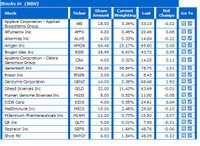
The Merrill Lynch Bitoech HOLDERS is a basket of stocks. When you buy a share of BBH, you own a piece of each of the companies. As you can see from this table, this basket is heavily weighted to the large cap compankies such as DNA, AMGN, GILD and GENZ. Interestingly, MLNM (which I think is one of the worse companies in this sector and I will be sure to write a blog entry about it) has a relatively high share. No sign of VRTX, AMLN, PDLI,CEPH or RNAI. This is probably the weakest of the three indices because it has a limited number of company and it is biased towards large cap stocks.Bottom Line
After analyzing the three indices, it is my opinion that NBI is the most relevant index unless you own DNA or AMGN then I would use the BBH. BTK has an advantage because it is equal weighted but it does not have enough of relevant biotech stocks to make it a good index. You could make your own basket of relevant equally weighted 50 biotech stocks (all in the same growth stage) that would be better than any of the above indices but who has time for that?
If you want to track the performance of biotech companies that are not large cap such asDNA, AMGN, GENZ, BIIB, you can use the difference between NBI and the BTK. The comparison between BBH and BTK could be used to determine the effect of weighting. BBH, the weighted index of 17 stocks is down 13% YTD while BTK the equally weighted index of similar 20 stocks is down only 3% YTD.
To me this suggest that the large cap biotechs have been hurting the most in this sector. In fact if you look at my CELG article , you can see a table that shows relatively low PE and relatively low expected growth rates for the large cap biotechs. The 2007PEG(PE07/growth ratio) for these stocks is between 1.42-1.93, which makes them fairly valued. Historically, these companies have had higher PEs and PEGs and as sector rotation puts Bitoech back in favor, I expect these stock prices and PEs to increase. Of course, this assumes no changes in the companies’ businesses going forward. As new products are launched or mergers occur, these companies could take off.
JMHO