Showing posts with label VRTX. Show all posts

Saturday, July 25, 2009

Decoupled moves in Biotech indices highlight opportunities and challenges

The chart below shows returns for the last 6 months of the two Biotech indices that I follow: BTK and NBI.

After a significant and equivalent downside move in March, both indices have turned positive with an explosive move since middle of July. I speculate that the March downside move was a response to concerns over Obama's health care proposal and its impact on Medicare. However, upon further examination, the adjustments in Medicare rebates would translate to no more than a double digit change in revenues. Moreover, the biotech story is in large a product story where launch of a new product has a much higher impact on revenues than any adjustments in rebate system which can be overcome with cost and price adjustments and while keeping healthy profit margins.

The explosive returns in July are rather interesting and may be indicative of things to come. The divergence in the charts of two indices (35% return for BTK vs. 12% for NBI) underlying story of the biotech industry. This trend indicates a value disparity between mid-large cap biotechs and smaller companies. The BTK move can be contributed to recent earnings and product advancement reports coming out of Celgene (CELG), Gilead (GILD), Amgen (AMGN) and other pharma companies that highlight decent earnings growth despite a challenging environment in addition to value added product development successes.

The M&A activity over the last few quarters have just contributed positively to perceived value of these stocks as the recent acquisition of Medarex (MDRX) highlights a larger trend of big pharma acquiring biologics assets and capabilities. This has resulted in speculative run-ups in shares of other companies such as Elan(ELN) and Seattle Genetics (SGEN) who have biologic portfolios. This trend, however, could reverse as rapidly if no new deals are announced in the next few months.

The muted returns in the NBI index highlights the financing concerns that still remain for smaller companies which may cause a wave of consolidations, bankruptcies and asset sales at depressed values.

My favorite large cap names are Genzyme (GENZ) and Amgen(AMGN) and Biomarin (BMRN) and Vertex (VRTX) among mid-sized companies.

Disclosure: The author has no direct stock or option positions in any of the stocks mentioned in this article.

Tuesday, April 01, 2008

Early data suggests Telaprevir may be helpful for patients who need it most

On Monday March 31st, Vertex announced, through an abstract, the interim results of an open-label phase 2 trial for Telaprevir for treatment of Hepatitis C. 26 of 32 patients who previously failed other therapies (81%) experienced rapid virologic response (RVR) after four weeks of treatment. Even though these rates may not be sustained in longer term, chances are a good portion of these patients will be cured.

The release of these results have prompted analysts who disliked the company and the stock last week to all of a sudden change their minds. I was surprised at the timing of this news as I was expecting some results released in second half of this year.

If you read through some of my past articles, you will find that I have violated almost every rule of investing when it comes to Vertex Pharmaceutical's stock (VRTX). In fact, I have even called my behavior stubborn, which always guarantees significant losses when trading or investing.

But my fascination has always been with Telaprevir not the stock or the company. I have always believed that this drug had the best potency, efficacy and side effect profile which would make it a standard therapy for Hepatitis C, a disease with poor standard of care therapy. I won't get into the biochemical details but this is not something easily reproducible by other pharmaceutical companies. This partially explains why other similar products have failed or have had major set backs in the clinic.

Some people have blamed the recent volatility in the stock price on the management over promising results. In fact there has been some class action law suits filed. I am not a legal expert but I doubt they will serve any purpose besides costing the tax payers some money and making some lawyers rich. The law suits will end up getting thrown out of court andI wish someday the laws will change to stop these ridiculous and destructive behaviour!


The stock may fluctuate 50-60% in a year but the story remains the same. Telaprevir is the first Hepatitis C Protease inhibitor in Phase III clinical trials. It is the only drug to show significant improvement to standard of care in both treatment naive and non-responding patients and it will be the first one on the market as early as late 2009 (maybe!). It has the potential to becoming a multi-billion dollar drug, and for that VRTX should be valued no less than 5 billion dollars or about 50% higher than current price of $25.4. I am basing this on other blockbuster phase III products such as Celgene's Revlimid.


Bottom line: Buy Vertex for the long term for a once in a lifetime return!


Disclosure: The author has a long position in this company.

Sunday, October 21, 2007

Vertex's sell off is a great buying opportunity


Vertex Pharmaceutical's stock (VRTX)dropped about $5 or 14% to $30 on the news release that Schering Plough's Protease inhibitor Boceprivir, which had performed poorly in previous trials, showed that about 79% of patients achieved early response. As soon as this news came out( with no trial result detail) , an analyst from Cowen and Co. downgraded Vertex due to concerns from competition.

First of all, the size of this market (up to $4 billion annual estimated sales) makes competition less of a factor. Second, being first to market increases the probability of success of any product but it does not guarantee it. Third, the details of the Schering trial will make us realize that Telaprevir is still argubly the best product with most clinical data. For example, in the Boceprivir trial, patients were primed with Peg-interferon and ribavirin before the start of triple drug therapy. Also, no long term sustainability of response rates are available beyond the original 12 week data mentioned in the abstract. Finally, the drop out rates due to side effects, the unknown methodology for calculation of percent responders as well the higher minimum detection limit of the PCR assay used to determine virus levels makes me question the strength of these results.

I still believe Telaprevir is the front runner to hit the market before any other new HCV medications and will capture a good percentage of the world wide market thanks to its partnership with J&J.

VRTX stock is a great buy at these levels as I believe a blockbuster product in a multi-billion dollar market should value the company between $6-10 billion market cap once Telaprevir is in Phase III. Days like these, I am glad that the efficient market theory, which is taught at every fiance school, is somewhat flawed for smaller companies and individual investors can take advantage of under-priced securities. As retail investors, we should recognize and plan for these events.


I had previously owned stocks and leaps in VRTX. Given this recent movement, I have added some medium term calls 2-6 months, to take advantage of a possible run after the earnings report and the release of more clinical trial results in November. However, given the difference of opinion by analysts and other shareholders who have sold their shares recently, I am holding on to some puts as a hedge.

Bottom Line: Buy VRTX at these levels and hold for a long term for a possible 2-5 times returns in the next few years.

Disclosure: The author owns shares and options in VRTX.

Wednesday, May 16, 2007

Vertex Pharmaceutical's (VRTX) Telaprivir is effective, but path to market needs clarification

On April 14th, Vertex Pharmaceuticals release highly anticipated Phase II clinical trial (PROVE1) results of its Hepatitis-C treatment Telaprivir. The results of the interim analysis are shown in the table below. The full press release with additional information can be found here.


The results look impressive as they show a rapid response in Telaprivir treated patients vs. plaebo in the first 4 weeks. However, the interpretation of results at 12 weeks becomes questinable due to lack of statistical significance. Analysts were focusing on a small subset of 20 patients who were to receive the Vertex drug for just 12 weeks and then be checked 20 weeks later for signs of relapse. Here is the quoted text from the press release regarding those 20 patients:

"Analysis of PROVE 1 Patients who Finished All Treatment at 12 Weeks. Seventeen of 175 patients received at least one dose of telaprevir in “Arm D” of the PROVE 1 study (telaprevir + peg-IFN + RBV). According to the study protocol, patients in Arm D were eligible to stop all treatment at week 12 if they met on-treatment criteria, including the achievement of RVR (<10>The one obvious conclusion that can be made from looking at this data is that the number of patients are too low to make any extrapolation on percent responders. The other conclusion is that 12 week therapy may not be sufficient to reach undetectable levels in a significant portion of the patients. However, the fact that more patients respond to longer periods of treatment with standard of care ( SOC is Interferon + Rivbavirin) suggests that patients on SOC + TVR may also benefit from this increase. The company has already started Phase II ( Prove 2 and 3) trials with larger number of patients with regimens of at least 24 weeks. This means longer clinical trials, higher costs of trials and lower chance of a quick approval and launch in 2009. This would explain lack of a upward stock movement after the release of the results.
The other issue of higher incidence of drop outs should not be a significant issue. Since, this was a trial most patients and physicians are careful with side effects. In practice and after approval, it is safe to assume more patients will be encouraged to withstand the side effects (severe rash which exists in SOC and can be treated).

VRTX has also released their quarterly financial report and as expected they spent a significant amount of money on materials for phase III clinical trials which are expected to begin in Q4. Even after paying down some long term debt, VRTX still has a hefty $655 million in cash and short term securities which should be enough to fund the launch of Telaprivir.


Since the release of earnings and clinical trial results the stock has been trading between $30 and $32. I waited a few weeks before writing this post to see the reaction of the market to the data. The reaction of investors since then has been of cautious optimism. The stock seems to have found a support at $30, but if there is a large sell-off in the market, VRTX will see more volatility than stocks with earnings. The data has clearly shown that Telaprivir is safe and is an improvement to existing therapy, giving it a high probability of becoming a blockbuster. The rest of Phase II data, which are scheduled to be released in November will determine the inevitable path to market. The stock should end the year higher than these levels and has a minor probability of a significant downside given the size and unmet need of HepC market.


Wednesday, December 27, 2006

Vertex Pharmaceuticals (VRTX) stock likely to trade in a range.


It seems like VRTX is the subject of the majority of my articles (link one, two, three to past articles) and for good reasons. VRTX is looking to become one of the rare success stories in a very tough industry by launching a product with huge commercial potential against Hepatitis-C Virus which currently does not have great treatment and is a large epidemic problem.

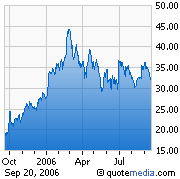
The chart to the right shows the recent

resistance created at $45.00 which coincided with the release of interim safety updates from Phase II trials of Telaprivir.

Of patients who received the drug in clinical trials, 9% discontinued treatment due to side effects such as rash, gastrointestinal disorders and anemia, and 3% stopped treatment due to side effects that were considered serious. After 12 weeks, 65 out of 74 patients had undetectable levels of the virus, Vertex says. It should be pointed out that these patients are also taking the standard treatment of Ribavirin and Peg-Interferon (Placebo) which already have a bad side effect profile. The key is to compare the Telaprivir arm of the trial to the Placebo. From what I read, the number of patients in the Placebo arm are significantly less than the drug arm and therefore any safety assessments are premature. However, serious adverse effects in the Telaprivir patients that do not exist in the Placebo should be cause for concern. So far, I don't see any major and frequent side effects that would stop this drug from reaching the market. At the end, the overwhelming ( 88% )undetectable responders should be enough to advance this drug to the clinic unless some very serious unforeseen side effects show up in a larger study.

The news of advancement of the Aurora kinase inhibitor (really a multi kinase inhibitor) into phase II leukemia trials and receipt of a $25 million payment is a positive news but not one to move the stock significantly. I do not know the licensing arrangement between Merck and Vertex but I expect Vertex will receive about 10-20% of revenues plus upfront milestone payments. Overall, I think this product is worth about 200-500 million in market cap value which will not all be realized until the drug enters the market.

Also, the news of GSK dropping the HIV inhibitor partnership should not be cause for concern because Vertex is losing a few million in milestone payments and about 10% ( based on past HIV drug royalties) in sales at launch.

Bottom line:

The recent imperfect clinical updates have resulted in a pause of the rapid share price gains seen in 2006. The recent and forthcoming milestone payments should help with the cash flows and upside earning/share anouncements in 2007. I believe the stock is failry valued between 4-5 billion and any moves below this range, unrelated to the clinical data, should be purchased. For aggressive traders, selling $45 calls and $30 puts could add some additional cash to the portfolio. I expect Vertex to trade between $35 and $45 in the next 6 months. I recommend to accumulate shares currently around $37 with a price target of $45 this year. As Telepravir enters Phase III, I expect the stock to trade between 6-10 billion ( compareable to recent biotech companies who have launched successful drugs) the Ultimately, even with great clinical trial results of both efficacy and safety, market lanuch is not going to happen until 2009! I am putting a hold rating on this stock. If you already have some shares there is no need to increase or decrease your position at this point as I expect VRTX to trade in a range in the next few months.

JMHO

Tuesday, November 21, 2006

VRTX a great company but the stock is overvalued

The charts show clear signs of short term correction. The stock price has appreciated 29% since end of October. The 50 day and 200 day moving averages are at 37 and 35.5 respectively. There is a lot of room for correction here. The good news from positive mid trial updates have been priced in. The only other piece of news that may move this stock is some toxicology results that are due to come out.


At 5.7 billion market cap and about 2 years removed from launch, I think it is a good time to unload more shares and options and wait for a better buying opportunity. I plan to purchase January $45 puts at $3.5 and wait for stochastics to signal oversold before going long with calls again.

I addition Susquehanna started coverage of VRTX with a negative rating that may weigh on the shares.

Sunday, October 29, 2006

Vertex Pharmaceuticals (VRTX) update

Vertex recently announced interim results of VX-950 clinical trials for treatment of Hepatitis-C. Here is the link for the news release. 24 of 26 patients on VX950 and existing treatment of Pegylated Interferon and Ribavirin showed no detectable of Hep-C virus after stopping the therapy. Furthermore, the therapy was well tolerated which is almost as important as been efficacious.I have previously written about this stock link and think the company has a great future. After the latest anouncement, the stock soared by 17% as shown below in the chart.
I think the gap seen in the chart will be filled. I recommend selling January $45 calls which are now trading at $2.35. Selling calls has lower risk profile than buying either calls and puts but it does have a disadvantage that you are obligated to a potential trade until they expire. To hedge this risk, you can buy some January $50 calls with a portion of the proceedings in case the stock continues to go up.

Bottom line: I expect VRTX trading down or sideways for the next couple of months. You can take advantage of this highly probably scenario by either selling calls, buying puts or selling your shares and buying at a lower price. Either way, I don't think the stock could continue to go up in this market given that profitability is uncretain and still years away.

JMHO

Thursday, September 21, 2006

Vertex (VRTX) has the right formula for success

The recent slump in most Biotech names would make you believe that the industry is in trouble, but this may be a just a great opportunity to buy shares of great companies at a discount. One of the main attractions of this industry is the patentability of their products. The others are pricing power, high profit margins and relative immunity to economic conditions. They are however affected by political events and changes in regulations. But what attracts me the most is the virtual monopolies that some biotech companies enjoy. This virtual monopoly is a result of the extremely difficult challenges facing these innovative companies. There is a good amount of luck that is behind some of the great successful stories like Genentech (DNA), Amgen (AMGN), Biogen-Idec (BIIB) and Genzyme (GENZ). But what they all have in common is that they have a dominant product in a disease area with significant unmet medical need. This is what I look for when I try to find the next successful company. Who is going to come up with the next treatment for a disease that currently does not have a great therapy and also is coupled with a large enough market? This link to the Motleyfool.com also provides a great set of rules for investing in Biotechnology stocks.

Vertex Pharmaceutical (VRTX) has this success formula in their late stage product VX950 for treatment of Hepatitis-C. It has all the characteristics of a blockbuster that could propel Vertex into the category of a great biotech company.

First the market; Hepatitis-C is a devastating infectious blood born disease that could get transmitted by blood or sexual contact. It can survive outside the human host for up to a week and was not discovered until early 90's. Some think the whole US blood supply was contaminated with this virus in the 80's since there was not testing done yet. What makes this virus more dangerous is the fact that it has a dormant period of up to two decades. This means that we may have not even begun to see this epidemic yet. It is estimated that about 4 million people in the United States are infected with hepatitis C, which is about 2% of the population. The number of patients with chronic Hepatitis-C is expected to increase to 10.8 million in the next 10 to 12 years. Each year, there are about 35,000 cases of acute hepatitis C.

The treatment is difficult since by the time most people have found out they have Hep-C, their liver is severely damaged. The standard therapy is Pegylated-Interferon alpha, a protein that non-specifically increases the immune response and Ribavirin an antiviral. Unfortunately, this combination is not very effective. Last time I checked, the response rate was around 50%. Furthermore, the side effects are almost impossible to handle. I personally know someone who took these medications and he complained of having bad flu like symptoms every day for a year. This treatment is so bad that most people can not finish the 12 month duration and some become suicidal.

VX950 has shown tremendous efficacy with minimal side effects in early clinical trials. A phase Ib trial showed most patients responding very after a couple of weeks of treatment and in some cases the virus was completely gone which lead to the FDA granting fast track status. What makes VX950 special and hard to copy is that Vertex was a pioneer in this field. They were the first company to solve the 3D crystal structure of the protease protein that VX950 inhibits (they also did the same for HIV protease which revolutionized treatment of HIV). I don't want to get into the science but solving this structure and finding a molecule to specifically inhibit it that is safe and gets absorbed by the body is next to impossible. They have a huge head start and have solved some incredible problems. Even if someone wants to imitate this molecule, its chemical structure is so complicated that it makes manufacturing process development very difficult. VX950 is a direct result of huge perseverance by Vertex scientists and management mixed with some good luck.

Because of all these reasons, I believe VX950 will make it to the market and will be a multi billion dollar product with limited competition for a long time. The product is not expected to launch until late2008 (aggressive timeline) but at $3.5 billion market cap it has lots of upside movements left as this product moves through clinical trials. I expect Vertex's market cap to be around 7-10 billion right around the launch time and I will be aggressively buying dips from now until then. In addition to VX950, the company has products in trials to treat inflammatory diseases such as a p38 inhibitor which could be the first oral RA medication. They have a partnership with Merck to develop a kinase inhibitor for treating cancer and they have the first and second ever compounds in clinic to treat Cystic Fibrosis. Vertex should be admired for its science and should be a core holding in the biotech portion of any portfolio.


As of the posting date of this blog, Vertex is trading at $33.25 and should be accumulated aggressively. It has been consolidating since making its high of about $44 for a 25% correction and has found support at $30.

During this time, VRTX has made a partnership with J&J for distribution of VX950 outside US worth about $545 million while keeping sales in US. They have also raised $300 million in a public offering and have retired some convertible debt. These activities should provide enough cash for VRTX to get this product to the market and become a success story.


JMHO