Showing posts with label AMLN. Show all posts

Saturday, July 25, 2009

Decoupled moves in Biotech indices highlight opportunities and challenges

The chart below shows returns for the last 6 months of the two Biotech indices that I follow: BTK and NBI.

After a significant and equivalent downside move in March, both indices have turned positive with an explosive move since middle of July. I speculate that the March downside move was a response to concerns over Obama's health care proposal and its impact on Medicare. However, upon further examination, the adjustments in Medicare rebates would translate to no more than a double digit change in revenues. Moreover, the biotech story is in large a product story where launch of a new product has a much higher impact on revenues than any adjustments in rebate system which can be overcome with cost and price adjustments and while keeping healthy profit margins.

The explosive returns in July are rather interesting and may be indicative of things to come. The divergence in the charts of two indices (35% return for BTK vs. 12% for NBI) underlying story of the biotech industry. This trend indicates a value disparity between mid-large cap biotechs and smaller companies. The BTK move can be contributed to recent earnings and product advancement reports coming out of Celgene (CELG), Gilead (GILD), Amgen (AMGN) and other pharma companies that highlight decent earnings growth despite a challenging environment in addition to value added product development successes.

The M&A activity over the last few quarters have just contributed positively to perceived value of these stocks as the recent acquisition of Medarex (MDRX) highlights a larger trend of big pharma acquiring biologics assets and capabilities. This has resulted in speculative run-ups in shares of other companies such as Elan(ELN) and Seattle Genetics (SGEN) who have biologic portfolios. This trend, however, could reverse as rapidly if no new deals are announced in the next few months.

The muted returns in the NBI index highlights the financing concerns that still remain for smaller companies which may cause a wave of consolidations, bankruptcies and asset sales at depressed values.

My favorite large cap names are Genzyme (GENZ) and Amgen(AMGN) and Biomarin (BMRN) and Vertex (VRTX) among mid-sized companies.

Disclosure: The author has no direct stock or option positions in any of the stocks mentioned in this article.

Wednesday, August 27, 2008

Byetta may not be the cause of recent deaths, stock reaction unjustified

On Tuesday August 26, Amylin (AMLN) and its partner Eli Lilly (LLY) announced that four patients had died while on diabetes treatment Byetta.

Both Amylin (down 12%) and Lilly (down 1%) sold off in after hours following repeated headlines saying Byetta responsible for death.

The truth is no one knows what caused the death. The information released mentioned severe pancreatitis as a cause. Needless to say it is possible that pancreatitis, which happens with higher frequency on diabetic patients, was not caused by Byetta. Over a million patients have taken Byetta since it has been launched and the product has a good safety profile.

One patient was morbidly obese while other patients had major other complications such as surgeries.

I had previously recommended not to buy Amylin due to the lackluster uptake of Byetta and the inability of the management to manage expectations and earnings.

This is yet another case of a panic driven sell-off with incomplete set of facts. Once the dust clears, there is a very good chance that Byetta will be cleared.

I am recommending a short term long position in shares of Amylin (AMLN) which could be trading 10-20% higher in the weeks to come.


Disclosure: The author does not have any positions in AMLN of LLY.

Monday, June 23, 2008

Exanatide's convenience may not be enough in a tough Diabetes market place

Diabetes is a tough market to compete in for any company. Insulin is the standard therapy for most patients with severe Diabetes. It is a naturally occurring hormone and it exists as both short acting and long acting therapy. It requires close monitoring as it may have dangerous side effects. This is the hurdle that any product entering the market has to pass. The new product would have to be safer and more efficacious than insulin to get wide acceptance. One of the serious side effects of any potent therapy is the drop of blood sugar levels below safe levels or hypoglycemia. If a product is equally safe and efficacious, it will have a tough time beating Insulin unless it is more convenient. This is an over simplification of the many problems these patients face but it may be useful as a set of guiding principles when picking a stock.

In 2006 I suggested buying shares of Amylin Pharmaceuticals (AMLN) because I thought Byetta with its unique mechanism of action would result in a good alternative to insulin. Here is a link to that recommendation. The price then was around $40 a share. After three years on the market, the product has not helped the share price and the stock is trading today around $26. Some of this lack of performance could be the management's inability to turn a profit.


In June, Amylin announced widely anticipated results of its long acting version of Byetta called Exanatide. After one year of treatment, patients saw a significant drop in blood sugar levels and in weights. Analysts are applauding this result and despite heavy competition from Roche are recommending investing in Amylin at these levels.

When I began writing this article, I was tempted to recommend shares of Amylin at these levels based on the potential of Exanatide to be a multi billion dollar product. Also. the recent failures of inhaled version of insulin removed some potential competitive factors. However, given the risks of competition from other similar products and regulatory hurdles involved, I will hold off on recommending investing in AMLN unless it is done with speculative money. I have learned over the last few years that large institutional money flows into Biotechnology stocks only after uncertainties and risks are removed. Just because a stock is cheap does not mean it will move higher any time soon.

Another reason I am holding off on AMLN is the management factor. At some point, you just have to consider that great products are necessary but not sufficient in producing profits and therefore stock price gains. The promise of Byetta (whether imagined or real) never came to fruition. It is hard to identify the factor or factors that lead to these results, maybe the recommendations where made too early and could be filed under irrational exuberance. It is OK to try to hit home runs with stock picking if you realize that you will strike out a lot. Therefor, I recommend waiting until a winner emerges in this battle. By then, the results may be a single or a double but the higher probability of success would make it an investment grade decision instead of speculation,

Diabetes is a tough market!


Disclosure: Author does not have any long positions in AMLN.

Saturday, November 25, 2006

Amylin gets approval for Byetta in Europe

Amylin Pharmaceutical's(AMLN) stock continued the recent weakness despite announcing European approval of it's diabetes treatment Byetta. I have previously written about Amylin and had recommended to wait for a better entry point ( click here to see that article).

Some of this recent weakness could be due to some expected competition form the strong launch reported by Merck of it's diabetes drug, Januvia and the anticipated launch of Glavus by Novartis in 2007. Both Glavus and Januvia are from the same class of small molecules known as DPP-IV inhibitors. Byetta affects the GLP-1 pathway and thus provides a different means of controlling blood sugar in patients with diabetes.

It is too early to tell whether the DPP-IV drugs will dominate the market. It is most likely that the addition of all these new treatment options will provide different solutions to different patients. I believe that all these new products will increase the awareness of different treatment options. I also think that Byetta will continue to enjoy good market uptake because of an early launch and a different and unique mechanism of action.

I recommend addition of AMLN at current level of $41 or below.

JMHO

Sunday, October 15, 2006

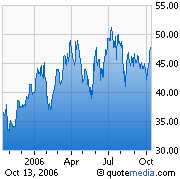
Amylin Pharmaceuticals (AMLN) - Byetta should pave the way to profitability, but not anytime soon

Amylin Pharmaceuticals, Inc. currecntly has two marketed products, BYETTA and SYMLIN, both injectable products to treat diabetes. Symlin is a synthetic analog of human amylin which is a naturally occurring hormone. Symlin and insulin work together with glucagon, another hormone, to maintain normal glucose concentrations. It is important to note that Symlin is co-administered with insulin. However, since insulin alone is sufficient in treating most patients, the addition of Symlin is not necessary in most cases. The breakthrough for treatment of diabetes would be a drug that replaces insulin, because insulin has lots of other side effects and is also very strong and may cause hypoglycemia if misused.

Byetta on the other hand has a different mechanism of action. Its active ingredient, Exenatide, is a synthetic exendin-4 peptide made of 29 amino acids. It is a long acting potent agonist of the glucagon-like peptide q (GLP-1) receptor which acts by regulating gastric emptying, insulin secretion, food intake and glucagon secretion. Byetta is used in treating type II diabetes in patients who are taking metformin and/or sulfonylurea, two common oral therapies, but have not achieved adequate glycemic control. This combination would spare the patients from using insulin. However, Byetta is not perfect and requires 2-3 daily injections, similar to Insulin. The company in partnership with Ely Lilly and Alkermes are working on a once a week injection of Exanatide which would be much more convenient if it is shown to control blood glucose levels as well as existing treatments. The company is conducting a phase III trial and does not expect to launch the product until 2009. Amylin has another partnership with Nastech Pharmaceuticals to develp intranasal version of Exanatide which may be launched by 2009.

In the first half of 2006 Amylin recorded $17.9 million in sales from Symlin (33% quarterly growth rate) and $166.8 million in sales from Byetta (45% quarterly growth rate). The company also had $15.8 million in collabortion agreements. For Byetta, Amylin shares revenues with Lilly. Amylin gets 50% of US sales and 20% of sales outside of US.

My estimates for Q3 2006 sales are about 170-175 million (assuming a minimum of 45% average growth). These sales growth numbers are not enough to get Amylin to profitability any time soon. Sales form Byetta are therefore considered to keep the company around until Exanetide LAR gets to the market. That is the blockbuster that the company needs to launch it into the upper echelon of bitoech sector. The company recently raised enough capital to ensure that it will get to that point ($850 million in cash on balance sheet)

The company is expected to record about $500 million in 2006 with a loss of about $1.88 per share and loss of $1.1 per share on about $800 million revenues in 2007. The stock currently has a market cap of $6 billion and is trading at $48.17.

Bottom line: Byetta is not the blockbuster to propel Amylin stock price to double in value, specially since they have to share revenues with Lilly. I don't see any catalysts to cause a significant increase in share price of this company. This company could trade side ways for the next few quarters and perform up and down based on the market and the sector. At $6 billion, Amylin seems to be fairly valued. I would recommend buying at or below $45(given no bad news). Depending on good sector performance and lack of bad news, it could trade as high as $64 (8 billion market cap) but not anytime soon.

There also remains some risks with at successful phase III trial of Exanatide LAR in addition to risk from competition including inhaled insulin being developed by Lilly. Another minor risk is approximately $375 million in convertible bonds that may get converted ar about $34/share and would be dilutive.

If you are tolerant of these risks and are willing to wait until 2009 to see any significant earnings you could start investing in AMLN. Personally, I am placing AMLN on my watch list.

JMHO